http://becauseimright-nocomme1.blogspot.com/

Kidnapped by Japan - How A Mother's Dying Wish Led To A Father's Unimaginable Loss

Read the story here
Showing posts with label ronald reagan. Show all posts

Tuesday, June 24, 2008

The Worst Political Ad In History

Sphere: Related Content

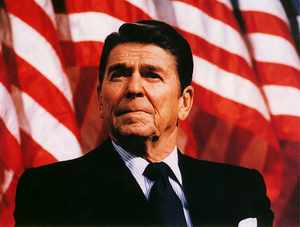
This ad which is magnificently filmed opens with President Ronald Reagan, the beloved giant of conservative Republicanism and is sonorously narrated by highly respected and beloved conservative former Senator Fred Thompson. It takes aim at the hypocrisy and failures of the Democrats with forensic precision. It builds and builds adding fact on top of emotion until finally the true purpose of it all comes into view, what we've all been waiting for...Could it be?...Is it really?...Yes, Yes...There he is...Its......John McCain?? The New York Times' favorite Republican?? That John McCain?

A political ad in which Ronald Reagan is the opening act for John McCain is something like going to a Rolling Stones concert and finding that they're the opening act for American Idol's Sanjaya. Happily sitting through Reagan and Thompson and then being "rewarded" with McCain is the equivalent of the most beautiful woman in the world giving birth to Pauly Shore. Instead of being a payoff, McCain's appearance is a huge letdown.

Attempting to make some sort of comparison between Reagan, who achieved his stature by clinging to and heralding conservative principles and McCain, who has spent a large part of his career disdaining them, is ultimately futile and probably counterproductive. That's why this spot, so well produced, which appeals to both the heart and the head, ultimately fails miserably and dismally and why it is the worst political ad in history.

Very simply the problem is: John McCain, you're no Ronald Reagan.

Cross Posted at The Patriot Room

Monday, May 19, 2008

Ted Kennedy - Spy

Sphere: Related Content


When the news came this Saturday that Senator Ted Kennedy had apparently had a stroke and his passing seemed potentially imminent all the talking heads on the news shows went into obit-speak, referring to the Massachusetts legislator in the past tense and reviewing all the "Lion of the Senate's" achievements and sterling personal qualities. This was to be expected as it is generally considered indelicate to speak ill of the (almost) dead but it also left the impression that Kennedy is a "great man" and has done much good for the country.

Well now that it looks like the Senator didn't have a stroke (apparently some seizures of still unknown origin) and will probably recover people can be allowed to take the rose colored glasses off and discuss Kennedy as he really is. Unlike the Left side of the blogosphere, we here on the Right haven't spent the last few days gathered around the pentagram chanting (and blogging) for our opponents' demise. We wish him a return to good health...while admittedly urging him to consider how the present time might be a good time for him to consider retirement.

Why retirement? Because after 45 plus years we on the Right think he has done enough damage. Most Americans are aware of the Ted Kennedy story and all its ugliness: Chappaquiddick, his virtual invention of the concept of "Borking" an opponent (wherein you scurrilously impugn the character of decent people to further a political agenda), the fact that he has been deeply involved in virtually ever national tax hike, bad immigration bill and every other anti-democratic, statist policy for decades, his alcoholism, the famous "waitress sandwich" episode, etc. An in-depth rehash isn't needed.

But there is a story that has gotten very little press which I'd like to review now and that is Kennedy's act of treason during the Reagan administration. In 2006 Paul Kengor wrote The Crusader: Ronald Reagan and the Fall of Communism. In researching it he made an interesting discovery:


FP:...Ok., let’s get to the intended main focus of our interview. There is a shocking revelation about a Ted Kennedy in your book. Tell us about it.

Kengor: In my book, I comment on, and publish, a May 14, 1983 document from the KGB archives that reveals that Senator Edward Kennedy (D-Mass.) reached out to the General Secretary of the Soviet Union's Communist Party, Yuri Andropov, to propose a kind of public relations strategy to counter President Reagan's defense policy initiatives toward the Soviet Union, policies that Kennedy felt were too aggressive.

FP: How did you come in possession of this document?

Kengor: As a result of an article that I wrote on FrontPageMagazine.com, titled, "Reagan's Freedom Fighter," which was about Natan Sharansky.

FP: So what can our interpretation be of this document?

Kengor: My intention in revealing this document was simply to place it in the historical narrative of the Reagan presidency as I did with hundreds of other documents in the book from the Soviet archives and various media archives. It is very important to understand that I tried not to cast judgment on the document or what it alleges that Senator Kennedy did.

Based on the document itself, as well as other Kennedy writings at the time, I believe that Kennedy did this because it was a very dangerous time and Kennedy, like many liberals, was genuinely worried that Reagan was too aggressive in his nuclear arms buildup.

Around this same time, Kennedy wrote a March 1984 article for Rolling Stone magazine in which he said that Reagan officials were "talking peace in 1984 as a prelude to making war in 1985." And he wrote of his "fears about an administration whose officials have spoken of winnable nuclear conflict." That was a reckless, irresponsible allegation, to be sure. Yet, it further illustrates where Kennedy was coming from: Clearly, Senator Kennedy was worried about the U.S.-Soviet confrontation spiralling out of control and going nuclear. He was seeking to defuse a situation that he thought could lead to nuclear war. His motivations were peaceful. This is not to say, of course, that what Kennedy allegedly did was not an example of very poor judgment and does not deserve heavy criticism, which it does. And what Kennedy did was obviously extraordinary.

FP: How are Kennedy’s actions relevant today in your view?

Kengor: First of all, I do not answer that question in the book because, as I said, I don't cast judgment on it in the book. However, if you're asking for my personal viewpoint, I do find it striking that certain American politicians were more worried about Reagan than about Yuri Andropov. In the KGB letter, which was written by the head of the KGB, Viktor Chebrikov, Chebrikov said that Kennedy was "very impressed" with Andropov. So, Kennedy was, By Chebrikov's account, impressed by Andropov but fearful of Reagan. Kennedy literally seemed more trustful of the Soviet dictator than the American president; that's a fair interpretation of Kennedy's thinking, based upon what Chebrikov reported to Andropov in the memo.

This kind of thinking is still common among much of the left today, as many liberals fear the conservative Republican president more than the dictator-enemy the president is trying to defeat. Today, there are many on the left who will tell you that George W. Bush is a greater threat to peace than Saddam Hussein ever was. This is a continuing example of poor judgment by the likes of Ted Kennedy.

FP: Kennedy was “very impressed” with the former head of the KGB? We don’t need to get into a history of the mass crimes that Andropov oversaw and ordered in that capacity. The ruthless suppression of Hungary's bid for freedom in 1956 was just one of them. Saying this about Andropov is the same thing as a person saying he was impressed with the head of the Nazi Gestapo. Where is the outrage on this shameful behavior?

Kengor: The mainstream media doesn't care. I literally have not received a single inquiry from the likes of the New York Times, CBS, or CNN. If not for the web and talk radio, and sources like FrontPage, there would be a total blackout on this revelation, and history would never learn about it. It is an amazing example of media bias, the most extraordinary example that I've ever personally encountered. Truly stunning. It makes me wonder how much history we never know.

FP: What Kennedy did, when all is said and done, was reach out a hand of solidarity to a monstrous and vicious totalitarian regime. Would we be so careful with our judgement of such an act if an American politician had done something similar with Nazi Germany?

When you refer to the non-existence of inquiry from the mainstream media into this outrage, what do you think lies behind it? I am focusing in on the psychology here. What is the mindset within the Left that exonerates this kind of behaviour, and, as some would argue, even supports it?

Kengor: It indeed requires a psychological explanation. They don't want to report it because it involves one of their own icons on the Left. So, they simply convince themselves that it doesn't matter or happened too long ago or that no one cares -- or whatever works.

To get a real flavor for what Kennedy was up to, it is instructive to read the KGB's letter to "Comrade" Adropov:


Special Importance
Committee on State Security of the USSR
14.05. 1983 No. 1029 Ch/OV
Moscow

Regarding Senator Kennedy’s request to the General Secretary of the Communist Party Comrade Y.V. Andropov

Comrade Y.V. Andropov

On 9-10 May of this year, Senator Edward Kennedy’s close friend and trusted confidant J. Tunney was in Moscow. The senator charged Tunney to convey the following message, through confidential contacts, to the General Secretary of the Center Committee of the Communist Party of the Soviet Union, Y. Andropov.

Senator Kennedy, like other rational people, is very troubled by the current state of Soviet-American relations. Events are developing such that this relationship coupled with the general state of global affairs will make the situation even more dangerous. The main reason for this is Reagan’s belligerence, and his firm commitment to deploy new American middle range nuclear weapons within Western Europe.

According to Kennedy, the current threat is due to the President’s refusal to engage any modification on his politics. He feels that his domestic standing has been strengthened because of the well publicized improvement of the economy: inflation has been greatly reduced, production levels are increasing as is overall business activity. For these reasons, interest rates will continue to decline. The White House has portrayed this in the media as the “success of Reaganomics.”

Naturally, not everything in the province of economics has gone according to Reagan’s plan. A few well known economists and members of financial circles, particularly from the north-eastern states, foresee certain hidden tendencies that many bring about a new economic crisis in the USA. This could bring about the fall of the presidential campaign of 1984, which would benefit the Democratic party. Nevertheless, there are no secure assurances this will indeed develop.

The only real threats to Reagan are problems of war and peace and Soviet-American relations. These issues, according to the senator, will without a doubt become the most important of the election campaign. The movement advocating a freeze on nuclear arsenals of both countries continues to gain strength in the United States. The movement is also willing to accept preparations, particularly from Kennedy, for its continued growth. In political and influential circles of the country, including within Congress, the resistence to growing military expenditures is gaining strength.

However, according to Kennedy, the opposition to Reagan is still very weak. Reagan’s adversaries are divided and the presentations they make are not fully effective. Meanwhile, Reagan has the capabilities to effectively counter any propaganda. In order to neutralize criticism that the talks between the USA and the USSR are non-constructive, Reagan will grandiose, but subjectively propagandistic. At the same time, Soviet officials who speak about disarmament will be quoted out of context, silenced or groundlessly and whimsically discounted. Although arguments and statements by officials of the USSR do appear in the press, it is important to note the majority of Americans do not read serious newspapers or periodicals.

Kennedy believes that, given the current state of affairs, and in the interest of peace, it would be prudent and timely to undertake the following steps to counter the militaristic politics of Reagan and his campaign to psychologically burden the American people. In this regard, he offers the following proposals to the General Secretary of the Central Committee of the Communist Party of the Soviet Union Y.V. Andropov:


1. Kennedy asks Y.V. Andropov to consider inviting the senator to Moscow for a personal meeting in July of this year. The main purpose of the meeting, according to the senator, would be to arm Soviet officials with explanations regarding problems of nuclear disarmament so they may be better prepared and more convincing during appearances in the USA. He would also like to inform you that he has planned a trip through Western Europe, where he anticipates meeting England’s Prime Minister Margaret Thatcher and French President Mitterand in which he will exchange similar ideas regarding the same issues.

If his proposals would be accepted in principle, Kennedy would send his representative to Moscow to resolve questions regarding organizing such a visit.

Kennedy thinks the benefits of a meeting with Y.V.Andropov will be enhanced if he could also invite one of the well known Republican senators, for example, Mark Hatfield. Such a meeting will have a strong impact on American and political circles in the USA (In March of 1982, Hatfield and Kennedy proposed a project to freeze the nuclear arsenals of the USA and USSR and pblished a book on the theme as well.)

2. Kennedy believes that in order to influence Americans it would be important to organize in August-September of this year, televised interviews with Y.V. Andropov in the USA. A direct appeal by the General Secretary to the American people will, without a doubt, attact a great deal of attention and interest in the country. The senator is convinced this would receive the maximum resonance in so far as television is the most effective method of mass media and information.


If the proposal is recognized as worthy, then Kennedy and his friends will bring about suitable steps to have representatives of the largest television companies in the USA contact Y.V. Andropov for an invitation to Moscow for the interview. Specifically, the president of the board of directors of ABC, Elton Raul and television columnists Walter Cronkite or Barbara Walters could visit Moscow. The senator underlined the importance that this initiative should be seen as coming from the American side.

Furthermore, with the same purpose in mind, a series of televised interviews in the USA with lower level Soviet officials, particularly from the military would be organized. They would also have an opportunity to appeal directly to the American people about the peaceful intentions of the USSR, with their own arguments about maintaining a true balance of power between the USSR and the USA in military term. This issue is quickly being distorted by Reagan’s administration.

Kennedy asked to convey that this appeal to the General Secretary of the Central Committee of the Communist Party of the Soviet Union is his effort to contribute a strong proposal that would root out the threat of nuclear war, and to improve Soviet-American relations, so that they define the safety of the world. Kennedy is very impressed with the activities of Y.V. Andropov and other Soviet leaders, who expressed their commitment to heal international affairs, and improve mutal understandings between peoples.

The senator underscored that he eagerly awaits a reply to his appeal, the answer to which may be delivered through Tunney.

Having conveyed Kennedy’s appeal to the General Secretary of the Central Committee of the Communist Party of the Soviet Union, Tunney also explained that Senator Kennedy has in the last few years actively made appearances to reduce the threat of war. Because he formally refused to partake in the election campaign of 1984, his speeches would be taken without prejudice as they are not tied to any campaign promises. Tunney remarked that the senator wants to run for president in 1988. At that time, he will be 56 and his personal problems, which could hinder his standing, will be resolved (Kennedy has just completed a divorce and plans to remarry in the near future). Taken together, Kennedy does not discount that during the 1984 campaign, the Democratic Party may officially turn to him to lead the fight against the Republicans and elect their candidate president. This would explain why he is convinced that none of the candidates today have a real chance at defeating Reagan.

We await instructions.

President of the committee
V. Chebrikov


So while the duly elected President of the United States was trying to conduct his foreign policy (which later proved to be uniquely successful), Senator Ted Kennedy was trying to conspire with the Soviet Union, the most murderous nation in the history of the world, to subvert that policy.
The only conclusion is the obvious one: Ted Kennedy committed treason. And like the manslaughter of Mary Jo Kopechne, he got away with it.

While it is not "polite" to speak ill when someone seems near death, it would also be dishonest not to acknowledge the bad things they have done as well. But dishonesty fits Ted Kennedy like a glove so the glowing "memorials" come as no surprise. But we who know better shouldn't forget. And we won't.

Sister Toldja comments on Kennedy's illness
So does Common Sense Political Thought
Wizbang comments

Thursday, May 15, 2008

Whom Gods Would Destroy - The Coming Republican Bloodbath

Sphere: Related Content


A portent. An augury. An omen. You don't need a crystal ball or psychic ability to recognize that Tuesday's Republican House seat loss in Mississippi, the third such recent special election House loss in a previously safe Republican district is spelling out potential catastrophe for Republicans in November. Reid Wilson on Real Clear Politics spells out some of the very troubling behind-the-scenes reactions in Washington:

"The political environment is such that voters remain pessimistic about the direction of the country and the Republican Party in general," Cole continued. "I encourage all Republican candidates, whether incumbents or challengers, to take stock of their campaigns and position themselves for challenging campaigns this fall by building the financial resources and grassroots networks that offer them the opportunity and ability to communicate, energize and turn out voters this election."

Still, losing heavily Republican seats in the Deep South is a big blow to the Washington GOP. "To lose two Southern seats in two weeks, I mean, oh my God," the leadership aide said. The aide told Real Clear Politics that something new is going to happen at the NRCC. "People look at Cole, and they say, 'What are you going to do to change?' And if he doesn't want to change, change is going to be forced on him."

A top adviser to a Republican incumbent who has a difficult race in November already says his boss is not looking to the NRCC for the same help he got in 2006. "This chairman badly underestimated how important it is to have top-flight staff," the adviser said, adding that some NRCC staffers are "toiling" under supervisors with less campaign experience. "We had been planning all along to operate without much help from them."

The leadership aide suggested that a former NRCc chairman, Virginia Rep. Tom Davis, could take on a larger role in the coming months. Davis, who is retiring after this session of Congress, ran the committee earlier this decade and currently serves as chairman of the NRCC executive committee. The adviser suggested, instead, that the wounded NRCC presents an opportunity for other members of the caucus to help out their fellow Republicans with political action committee donations, setting up future advancement for themselves.

The troubling thing about this insider info is that while the Republicans are seeing the writing on the wall the only thing they seem to be able to think to do in response is fine-tune their campaign machinery. Well that's ok. You need to be well organized in order to win an election. What they seem not to understand is that you also need a message.


The reason Republicans are held in such low regard is that they went from being Bob Michel country-club Republicans to being Newt Gingrich rebel-young-Turk Republicans and then right back to being country clubbers again. They have become the epitome of big spending, out of touch pols, more interested in perks than people. What they need is a revitalized message built on Reagan-Gingrich style principles. It is probably too late at this point. You can't show up at the 11th hour and say "Forget the last ten years. Now we believe in something again." The credibility just isn't there.


While salvaging November may no longer be possible, it isn't too early to recommit to conservative policies as a foundation from which to run in future elections. The head of the ticket (John McCain - boo hiss) certainly isn't going to energize the base but the stirrings of some real commitment to conservative principles, even now, might be enough to save some House and Senate seats.


On Brit Hume's show on Fox tonight I saw House Minority Leader John Boehner saying that, yep, this is "another wake-up call." He looked awake alright but he didn't look like he knew what to do with his new found consciousness. I'm glad you're awake, Mr. Boehner, now please just act like a conservative. When you think about it, it isn't that much to ask for, is it?

Liberty Pundit shares in the disgust
And so does Below The Beltway

Tuesday, May 6, 2008

And Now The Award For Worst Actor In A Celebrity Endorsement - The Winner Is - Tom Hanks

Sphere: Related Content

Beware: Celebrity Endorsement


Okay, we know Tom Hanks is the modern Jimmy Stewart, a terrific and entertaining actor as well as being a smart producer, solid writer and good director. He's a bright guy. So then could somebody please explain what the Hell that thing is up above?

Hanks sits there, pasty and poorly made up, almost, but not quite, looking directly into the camera and, with the enthusiasm of someone telling you about their last visit to the dentist proceeds to endorse (I know it is a shock) Barack Obama. Apparently not able to get the whole, not very long speech in one take, Hank's camera jerkily turns off and on as he reads the uninspired ("...history with a capital "H"...) and historically suspect (Was Washington turning over power to Adams really the first time in "recorded human history" when there was a peaceful transfer of power to a non-relative??) tract he proudly admits to having written himself. An utterly abysmal performance.

It is odd that an actor of real gifts is able to convincingly mouth the words other people put in his mouth should be so completely unconvincing when mouthing his own thoughts. If he wants some pointers about how this thing should be done he might check out the following:


Tom Hanks, I feel I knew Ronald Reagan. Ronald Reagan was a President of mine. Tom Hanks, you're no Ronald Reagan.

Tuesday, March 11, 2008

Couldn't They Tell?

Sphere: Related Content

After hearing about New York Governor Eliot Spitzer's admission yesterday of his involvement with a prostitution ring my first reaction was: Oh, so that's what its going to be. By that I mean I was somewhat surprised about the particulars of the revelation but I can't say that I was surprised that Spitzer, well known as arrogant, heavy-handed, mean, vindictive, egotistical and just plain unpleasant, had managed to shoot himself in the foot.

When I heard that he'd been elected, and in a landslide yet, I thought that it was just a matter of time before he would do something stupid, really stupid. Not that Spitzer himself is stupid. Far from it. Scoring a very impressive 1590 on his SATs Spitzer went on to Princeton U. undergrad before going to Harvard Law where he edited the Harvard Law Review. And his ambition has been the equal of his brains. Eliot Spitzer has never missed an opportunity to make an impression, always going after the high profile, big pr cases; going after pregnancy crisis centers to please New York's pro-abortion Left, payola in the music industry, big shot businessmen. He was a legal Master of the Universe. So taken with his own gifts and position was he that he thought anything he did was acceptable merely by virtue of the fact that he did it. He'd make calls threatening people, inappropriately used the State Police to investigate his chief nemesis, Republican State Minority Leader, Joseph L. Bruno, arrogantly issued an unpopular executive order allowing driver's licenses to be issued to illegal aliens.

He was also widely despised by almost everybody who ever had the bad fortune to have dealt with him, which explains why so few people are willing to come to his defense now. So when news came yesterday that he had finally imploded, it was not exactly the year's biggest shock.

What does surprise me however is the way the American people continue to elect catastrophes waiting to happen like Spitzer. Here's a confession: I'm not a genius; just a fairly regular guy (despite being "Right" so dang often) but I knew this guy was, what's the word I'm looking for? Oh, yeah...a freak. Couldn't the 69% of voters who put Spitzer in office see this, too? Apparently not.

But Americans have a long and impressive history of voting for dysfunctional politicians. The last fifty years alone have produced such giants of history as Louisiana Governor Earl Long, who was committed to a mental hospital while in office; Cincinnati city council member and then Mayor Jerry Springer (yes, that Jerry Springer) who resigned after a revelation of his patronizing (surprise!) a prostitute; Washington DC Mayor and crack addict Marion Barry; President Richard Nixon, whose paranoia and generally warped psyche have been fodder for books for decades and Bill Clinton, a self involved narcissist whose entire Presidency was about one thing and one thing only: him. All that is missing from each of these distinguished gents is a day glow etching of the words HELP ME on their foreheads.

Now it is a truism that bright, talented people who seek office often have gargantuan egos. Ronald Reagan was that rarity among rarities who was both an actor and a politician, both lines of work which attract egomaniacs, who was actually well adjusted.

The public can be forgiven for not spotting some political rotten apples. In the ordinary course of life everybody gets surprised by the behavior of some of the people they thought they knew, so politics, too can be expected to provide the unexpected now and then. But how do you explain an Eliot Spitzer? I wish I could provide an answer here but the subject of the election of stone cold losers doesn't come with any. It just comes with one big question for those who put them in office: What were you thinking?

Tuesday, February 26, 2008

The Consequences Of Vacuous Hope

Sphere: Related Content


I have just come back from a very special place, a wondrous place. It is a land in which the fortunate step on the less fortunate with impunity, where old folks and young jockey for the same low wage jobs, where no people feel united with their fellows, where hope is lost. But wait: there on the horizon in this magical land is one special man who brings change and hope, who shoulders the burdens for all the rest of us, the man who has the answers. He is a man of such sure character we don't have to ask him questions, we just let him open the doors to all that can be. Our only responsibility is to close our eyes and say, "Yes we can. Yes, we can change. Yes we can."

I have just spent an hour reading Senator Barak Obama's campaign speech transcripts.

Watching Obama on TV delivering these same speeches is a very different experience from reading them. Listening to his voice rise and fall and watching him react to the crowds reacting to him, his words take on a heft and weight that they totally lack when reading them on the page. Watching him deliver such lines as, "Yes, we can heal this nation. Yes, we can seize our future. ... as we leave this great state with a new wind at our backs and we take this journey across this great country, a country we love, with the message we carry from the plains of Iowa to the hills of New Hampshire, from the Nevada desert to the South Carolina coast, the same message we had when we were up and when we were down, that out of many, we are one; that while we breathe, we will hope", one feels the excitement of the moment, of something waiting to happen. But in reading the speeches the lines take on shallowness, a lightness as they almost seem to effervesce off the page, forgotten the second your eyes move on.

The speeches, meant as they are to be performed, dramatically repeat themes, two themes really: change and hope. But while they provoke our emotions, they do not provoke our thinking, quite the opposite; they require our suspension of thought. Barak Obama already has the answers. He'll carry the load. There are people and forces standing in the way of these answers. He just wants us to stand with him as he shoves those forces out of the way and then he can pass on his received wisdom: more money from the government, more government regulations, and more money taken from those who greedily have taken what they do not deserve. And this is the kernel of the problem of Barak Obama's call for hope.

Obama is asking us to hope that someone else (Obama himself!) will take the reigns of our lives. Ask people you know who support him why they do. In most cases they'll tell you what has now become a cliché: they're for hope; they're ready for a change. Generally specifics will be in very short supply. Ronald Reagan was known for his optimism too, but Reagan's speeches were always about returning responsibility for people's lives back to the people themselves. He wanted to be the agent to give the government back to the people. Obama wants to be the agent of the government which will take responsibility for the people. Now this is typical of liberalism, it is part and parcel of its appeal but what sets Obama apart from most liberal politicians is his ability to make the man and the message one and the same. He is the answer. He is the hope.

He is a most peculiar character to have so successfully convinced so many people to unquestiongly drop their skepticism. He is the least accomplished man to offer himself up as a presidential candidate in generations. A US Senator since only 2005, he's spent much of that time running for President, having little time to accrue much in the way of a legislative record, should he have the ability to do so. Although his speeches are rife with references to bringing people together, his record indicates no special ability in doing this. And although he seems to believe he possesses the answers to almost all our problems, new answers, he is in fact a perfectly traditional far-left politician. All those "new" answers are not new at all, of course. They have been ruining economies and nations for decades. The dying husk that is modern day Europe appears to be Obama's idea factory. If you like modern-day France, you'll love Barak's America.

Obama's ability to change the subject from the consequences of his ideas to his emotional state and then his ability to transfer that state to the public is nothing short of masterful. His audacity has been in thinking that he could make what he would actually do as President less important to the electorate than the fact that he is the one doing it. So far that audacity has paid off for him. I hope it no longer will come this November.

Saturday, February 16, 2008

Don't Know Much About History

Sphere: Related Content

If you were to ask the average American where Al-Qaeda came from you'd probably be met with a blank stare; not surprising considering the current quality of American education. If you were to ask a slightly better informed American the same question there's a pretty good likelihood that you'd hear that the US helped create them in Afghanistan in the 1980's. This would be just another example of the success of liberal opinion as propaganda and failure as fact. There's another story out there, a far more inspiring and instructive story and it has the benefit of being true.

Former White House speech writer and 9/11 Commission senior aid Michael Johns has posted a terrific piece, Charlie Wilson's War Was Really America's War, on his blog that clears away much of the fog that has blown in of late, covering the unlikely accomplishments of a relatively small number of visionaries (Charlie Wilson, Ronald Reagan, et al.) in bringing down the Soviet Empire and also in attempting to stop the growth of Al-Qaeda. Using the recent movie, Charlie Wilson's War (based on the eponymous book) as a frame of reference, Johns sets the record straight on the singular importance of US assistance to the Afghan freedom fighters following the 1970's invasion of that country, in the endgame of the Cold War. He also highlights how despite active US concern and intervention Osama bin-Laden and other non-Afghan forces began to emerge. Contrary to the Left's reinvention of this particular historical event, bin-Laden was not a creation of the CIA or the US at all . In fact, the Reagan Administration was aware of and sensitive to the mujahideen's concern over bin-Laden and his nascent movement, often taking direct, if covert action to mitigate its influence.

History often echoes to us here in the present and the events of that time sound eerily familiar to us as we hear the struggles of our current war. Like today, the Democrats of the 80's and 90's did all in their power to block a Republican president's long-range and ambitious plan to confront an implacable enemy. There was nothing sure and certain about the positive result of the final days of the Soviet Union just as there is nothing sure and certain about the results of our current conflict. In retrospect it is easy to see that our failure then would have been a continuing catastrophe for millions of people world-wide. What awful consequences might our failure now bring upon the world? Without remembering the past as it actually happened and learning its lessons it is possible we might just find out to our deep regret.