My thanks to Ed Morrissey of Hot Air for linking to our banner story, Kidnapped by Japan - How A Mother's Dying Wish Led To A Father's Unimaginable Loss on his post Transplants for the Yakuza?. Ed is a major force on the Right side of the blogosphere and his support here focuses some much needed attention on the story of Paul Wong, his daughter Kaya and others, too many others, like them.
Thanks again, Ed!
Kidnapped by Japan - How A Mother's Dying Wish Led To A Father's Unimaginable Loss
 Read the story here
Showing posts with label Paul Wong. Show all posts
Showing posts with label Paul Wong. Show all posts
Friday, May 30, 2008
Thank You, Ed Morrissey
Sphere: Related Content


Monday, May 12, 2008
Kidnapped By Japan - Update
Sphere: Related Content
The truly encouraging aspect of this news is that it shows that Japan is susceptible to international pressure and it should act as an impetus for further action to speed Japan along the way to rectifying its inhumane policy of kidnapping foreign children. Therefore the following actions from the original post are even more necessary than before:
International Family Law News and Analysis is also skeptical
 According to The Asahi Shimbum:
Japan to sign parental-abduction treatyWhile this sounds positive, any optimism must be tempered by the reality of the fact that, although Japan has agreed to sign the Convention, its requirements remain contrary to Japanese custom, calling Japan's commitment into question. Signing the Convention, which at best is still two years off, does not guarantee immediate action. In order for any real action to take place Japan will first need to overhaul significant portions of its family law system. More than that is required though as even modified laws are only as good as the judges and police whose job it will be to enforce the new system and historically they have frequently chosen to ignore mandates with which they disagree. Or as The Japan Times stated,
05/10/2008
BY MIAKO ICHIKAWA
Japan will sign a treaty obliging the government to return to the rightful parent children of broken international marriages who are wrongfully taken and kept in Japan, sources said Friday.
The Justice Ministry will begin work to review current laws with an eye on meeting requirements under the 1980 Hague Convention on Civil Aspects of International Child Abduction, the sources said. The government plans to conclude the treaty as early as in 2010.
The decision was reached amid criticism against Japan over unauthorized transfer and retention cases involving children. The governments of Canada and the United States have raised the issue with Japan and cited a number of incidents involving their nationals, blasting such acts as tantamount to abductions.
In one case, a Japanese woman who divorced her Canadian husband took their children to Japan for what she said would be a short visit to let the kids see an ailing grandparent. But the woman and her children never returned to Canada.
Once parents return to their home countries with their children, their former spouses are often unable to find their children. In Japan, court rulings and custody orders issued in foreign countries are not recognized.
Under the convention, signatory parties are obliged to set up a "central authority" within their government. The authority works two ways.
It can demand other governments return children unlawfully transferred and retained. But it is also obliged to find the location within its own country of a child unlawfully taken and retained, take measures to prevent the child from being moved out of the country, and support legal procedures to return the child to the rightful parent.
Sources said the Japanese government will likely set up a central authority within the Justice Ministry, which oversees immigration and family registry records. The ministry has decided to work on a new law that will detail the procedures for the children's return.
In 2006, there were about 44,700 marriages between Japanese and foreign nationals in Japan, about 1.5 times the number in 1996. Divorces involving such couples more than doubled from about 8,000 in 1996 to 17,000 in 2006.
“Professor Colin Jones of Doshisha University testifies in a recent law journal article, ‘In the Best Interests of the Court: What American Lawyers Need to Know about Child Custody and Visitation in Japan,’ … Japanese courts often act in the ‘best interests of the court’ to protect themselves from becoming irrelevant to society due to their inability to enforce their own orders. This authoritative source ensures that future judges will understand the unique meaning of the ‘best interests of the child’ in Japan and realize that even Japanese court orders are not enforceable, so neither are foreign ones.”To compound the uncertainty, whatever inroads are made in the current system with the impending signing of the Hague Convention, the case of Paul Wong and his daughter Kaya remains even more problematic than most as it doesn't involve a divorce as do almost all other cases of Japanese child abduction, but involves one parent's death. Although this might logically seem more straightforward, the fact that it is an unusual case may very well place it outside whatever the rules for child custody of which Japan finally decides to abide.
The truly encouraging aspect of this news is that it shows that Japan is susceptible to international pressure and it should act as an impetus for further action to speed Japan along the way to rectifying its inhumane policy of kidnapping foreign children. Therefore the following actions from the original post are even more necessary than before:
This story needs the kind of exposure that will cause the Japanese government to feel the shame that it should. You can help by emailing Speaker of the House Nancy Pelosi here and Senate Majority Leader, Harry Reid here. Let our Congressional leaders know of your awareness of this issue and your belief that it needs to be addressed now so that not another day passes where another American family and its children are torn apart, or in Paul's case, his daughter continues to be ripped away from her sole remaining parent to one day become a ward of the state.
In addition you can email your local newspaper, call local or national radio talk shows and inform them of this injustice.
The Japan Children's Rights Network offers a number of avenues that can be used to spread the word, as well and CRC Japan has a Yahoo group that can be used to help families torn apart by Japan's custodial policies get the word out.
Paul Wong can be reached at savekaya@yahoo.com where you can leave ideas, notes of encouragement etc.
And finally, if you have a blog please consider posting about this story. The fate of these kidnapped children is now in our hands.
International Family Law News and Analysis is also skeptical
Friday, May 9, 2008
Kidnapped by Japan - How A Mother's Dying Wish Led To A Father's Unimaginable Loss In The Land Of The Rising Sun
Sphere: Related Content
 Syria, North Korea, Venezuela, China, Cuba, Iran, Sudan...The list of countries that are at odds in serious ways with the United States is long and familiar to most Americans. But international relationships can and do change and the enemies of the past can become friends and there is no greater example of this than Japan. Americans today are far more likely to associate Japan with high tech, cars, Manga and a fierce economic competitiveness than they are to associate it with Pearl Harbor and Bataan. But even foreign friends are still foreign and Japan, as Westernized as it may seem, does not share all our customs and values. Which may explain why Japan is kidnapping American children.
Paul Wong is a 41 year old American lawyer who lived with his wife, Akemi and their daughter, Kaya in Hong Kong until Akemi died of cancer in December of 2005. Akemi, who became pregnant with Kaya four years after her cancer diagnosis knew she would not see her daughter grow up and made a request of Paul,
In fact Paul later learned that Kaya's grandparents began seeing an attorney nine months prior to any accusation of abuse in an effort to gain custody of her. The accusation of alleged abuse was made one month prior to when Kaya was scheduled to move back with Paul.
As for the possible motivations of Kaya's grandparent's, more may be involved than familial affection.
But Kaya's abduction is not the only one. There are currently 47 American children who have been removed to Japan. These are active cases reported to the US State Department in Washington, DC. The US Embassy in Tokyo reports over 80 active cases involving American children, but state that many more go unreported.
 Syria, North Korea, Venezuela, China, Cuba, Iran, Sudan...The list of countries that are at odds in serious ways with the United States is long and familiar to most Americans. But international relationships can and do change and the enemies of the past can become friends and there is no greater example of this than Japan. Americans today are far more likely to associate Japan with high tech, cars, Manga and a fierce economic competitiveness than they are to associate it with Pearl Harbor and Bataan. But even foreign friends are still foreign and Japan, as Westernized as it may seem, does not share all our customs and values. Which may explain why Japan is kidnapping American children.
Paul Wong is a 41 year old American lawyer who lived with his wife, Akemi and their daughter, Kaya in Hong Kong until Akemi died of cancer in December of 2005. Akemi, who became pregnant with Kaya four years after her cancer diagnosis knew she would not see her daughter grow up and made a request of Paul,
"When Kaya was born, I promised my wife that we would move to Japan so that our daughter would know about her Japanese heritage and Akemi, despite her own illness, could care for her elderly parents."After Akemi's death, Paul in fulfillment of his promises to his wife, made plans to start his life over again, leaving a successful career, to move to Japan for his daughter and his wife's parents.
 Akemi, Paul and Kaya on Kaya's 2nd birthday
Her mother's parents, knowing that Paul would be relocating to Japan, asked if they could watch Kaya temporarily before he moved to Japan. Kaya went to her mother's parents' home in Kyoto, and while there, Paul visited monthly, traveling to Japan from Hong Kong, as prepared to move to Japan.
As reported by ABCNews.com,
Once he found a job and was preparing to move, however, things suddenly changed.
"Once I moved to Tokyo last year, the grandparents did everything possible to keep Kaya away from me. When I said I'm taking her back, they filed a lawsuit against me filled with lies and claimed I had sexually assaulted my daughter. There are no facts and the evidence is completely flimsy."
According to Wong, with the exception of one long weekend in September 2007 when he took his daughter to Tokyo Disney, her grandparents were present every time he was with Kaya.
He said that a Japanese court investigator found that the girl was washed and inspected every day after a swimming lesson at her nursery school and her teachers never noticed signs of abuse.
In fact Paul later learned that Kaya's grandparents began seeing an attorney nine months prior to any accusation of abuse in an effort to gain custody of her. The accusation of alleged abuse was made one month prior to when Kaya was scheduled to move back with Paul.
As for the possible motivations of Kaya's grandparent's, more may be involved than familial affection.
Despite the lack of any substantiating evidence and objective factual evidence establishing the allegations as true, the Family Court in Tokyo recently permanently stripped Paul of his parental rights and awarded his daughter to her maternal grandparents on the the basis that, even if there is no evidence, "normal" people would not make up such a story, therefore "something" must have happened. The Court ignored all evidence establishing the allegations as false, including the findings of its own court investigator; never once mentioning them in its decision. This constitutes a violation of not only Paul's right to due process but is also a violation both his and Kaya's human rights.
Kaya's grandparents are elderly pensioners. Under a Japanese program to stimulate the birth rate, families with young children receive a monthly stipend from the government...
As Kaya has been taken from her father due, not to parental divorce but to her mother's death it represents the most egregious and callous example of the Japanese government's cancelling the rights of an American parent. But worse is the fact that Kaya will, upon the death of her grandparents, become a ward of Japan as her mother was an only child and there is no one else in the grandparents' family who can assume custody.
But Kaya's abduction is not the only one. There are currently 47 American children who have been removed to Japan. These are active cases reported to the US State Department in Washington, DC. The US Embassy in Tokyo reports over 80 active cases involving American children, but state that many more go unreported.
According to a US State Department Bureau of Consular Affairs flyer on International Parental Child Abduction as it relates to Japan,
Japan is not a party to the 1980 Hague Convention on the Civil Aspects of International Child Abduction.
Japanese civil law stresses that in cases where custody cannot be reached by agreement between the parents, the Japanese Family Court will resolve the issue based on the best interests of the child. However, compliance with Family Court rulings is essentially voluntary, which renders any ruling unenforceable unless both parents agree.
The Civil Affairs Bureau of the Japanese Ministry of Justice states that, in general, redress in child custody cases is sought through habeas corpus proceedings in the court. There is no preferential treatment based on nationality or gender. Although visitation rights for non-custodial parents are not expressly stipulated in the Japanese Civil Code, court judgments often provide visitation rights for non-custodial parents.
In practical terms, however, in cases of international parental child abduction, foreign parents are greatly disadvantaged in Japanese courts, both in terms of obtaining the return of children to the United States, and in achieving any kind of enforceable visitation rights in Japan.
The reason for the hopelessness felt by American parents who have been permanently deprived of their rights to any contact with their children can be understood by the flyer's next lines;
The Department of State is not aware of any case in which a child taken from the United States by one parent has been ordered returned to the United States by Japanese courts, even when the left-behind parent has a United States custody decree. In the past, Japanese police have been reluctant to get involved in custody disputes or to enforce custody decrees issued by Japanese courts.
In an effort to try to combat this overwhelming cultural and legal roadblock the parents of children abducted by Japan have banded together to form the Japan Children's Rights Network, whose website has had over 740,000 hits as of this date and the Children's Rights Council of Japan (CRC Japan), a US Based nonprofit group of parents of children abducted by Japan. Yet still the State Department's statement above, remains true:
The Department of State is not aware of any case in which a child taken from the United States by one parent has been ordered returned to the United States by Japanese courts...
Parents in numerous other countries such as Canada and the UK are experiencing the same fate as are American parents in the face of Japanese law and custom.
In addition to trying to fight for Kaya's custody in the courts Paul has also sought assistance from the US Congress where Senator's Norman Coleman and Amy Klobuchar of Minnesota have written to the Ambassador of Japan requesting a reevaluation of this situation. Also, Speaker of the House, Nancy Pelosi has written in protest, as well. Still, it must be remembered that entreaties by the Congress have been made before as has at least one request by the Vatican in a similar situation, all to no avail.
Japan remains one of the world's chief enablers for international child abductions. This fact has only recently begun to slowly attract international attention. Earlier this year the Canadian Embassy in Tokyo hosted a symposium on the Hague Convention and international abductions in Japan. This is currently a documentary film being made about this issue, and a trailer is available here.
The future now seems grim and clear; the Japanese courts and government are extremely unlikely to take any action to address this wrong against Paul Wong, an American citizen and his daughter, Kaya an American of dual citizenship and all the other abductees. Indeed Paul has already been advised that his chances of ever getting Kaya back through the Japanese courts are virtually hopeless because the Court will not change the status quo even if he wins on appeal.
"People inside Washington tell me the State Department has too much security and economic interest tied up with Japan. So they rather just let American parents lose their kids to the other parent who is Japanese. These people tell me the State Department actually wants the publicity and then Congress to jump in because then they can say to the Japanese we have to do this because of the American public and Congress."
After pursuing every legal and diplomatic avenue open to him Paul is now confronted with the reality of those words. He now believes that the...
"...only way Japan will change is to shame them with international publicity. This country hates that. They will outlast everyone by dragging things on and on but the one thing they will react to right away is public humiliation. Even the Japanese here say that's the only way if I ever hope to see my daughter again."
If Paul Wong is ever to be reunited with his daughter the Japanese government must have its behaviour in this shameful incident brought to light. That is where you come in. Conservatives believe in the importance, the centrality of the family. That is why Japan's policy of abducting American children while leaving their parents no real recourse is so offensive. How Japan handles Japanese family law is its own business but when that law results in American families being destroyed, of American parents and children being pulled apart, then Americans must act.
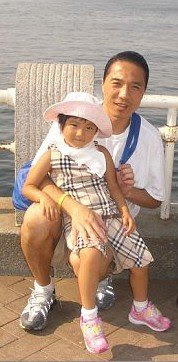 The last time Paul saw Kaya (August 2007)
As a single individual Paul Wong's options are limited but we as his fellow Americans can help.
This story needs the kind of exposure that will cause the Japanese government to feel the shame that it should. You can help by emailing Speaker of the House Nancy Pelosi here and Senate Majority Leader, Harry Reid here. Let our Congressional leaders know of your awareness of this issue and your belief that it needs to be addressed now so that not another day passes where another American family and its children are torn apart, or in Paul's case, his daughter continues to be ripped away from her sole remaining parent to one day become a ward of the state.
In addition you can email your local newspaper, call local or national radio talk shows and inform them of this injustice.
The Japan Children's Rights Network offers a number of avenues that can be used to spread the word, as well and CRC Japan has a Yahoo group that can be used to help families torn apart by Japan's custodial policies get the word out.
Paul Wong can be reached at savekaya@yahoo.com where you can leave ideas, notes of encouragement etc.
And finally, if you have a blog please consider posting about this story. The fate of these kidnapped children is now in our hands.
Cross Posted at Liberty Pundit
There is an update on this story here
Thanks to Ed Morrissey for his attention to this story here
Subscribe to:
Posts (Atom)